
Best Places to Live in Hampton Roads, VA: Choosing the Right City |
Compare seven cities by housing, commute, beach access, and everyday lifestyle |
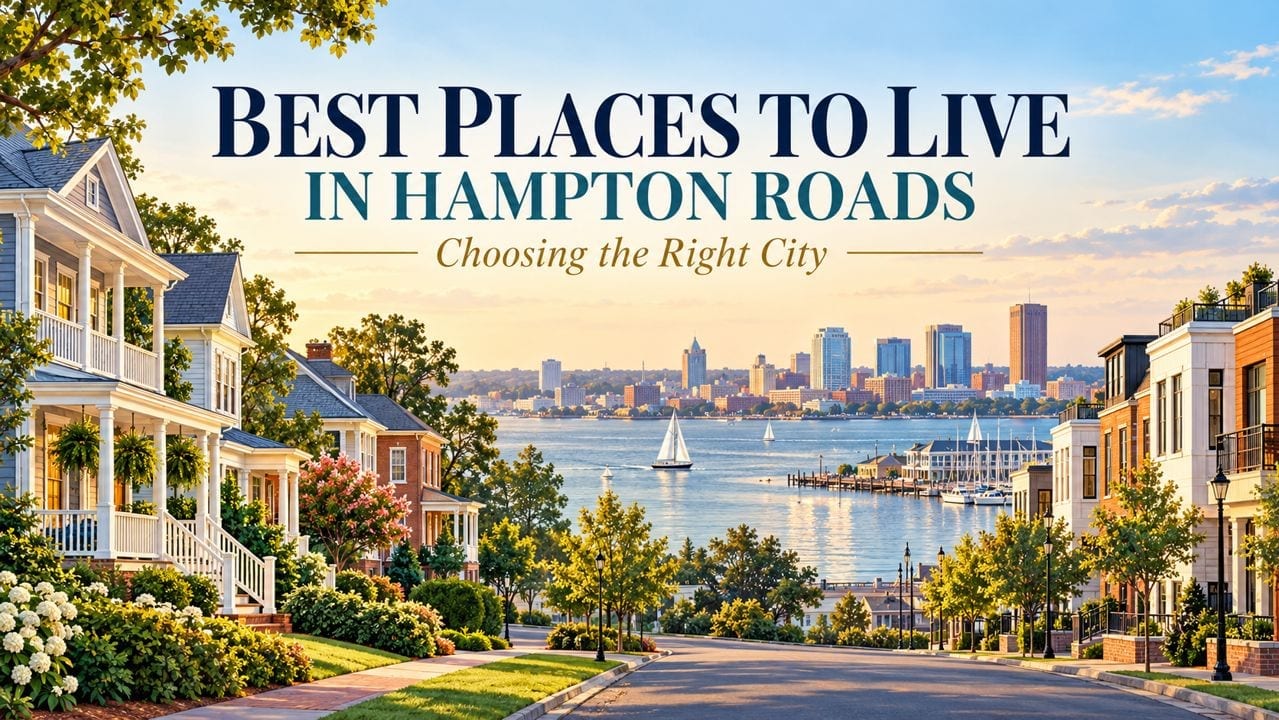
Moving to Hampton Roads means choosing more than a house.
Your city determines which bridges you cross, how easily you reach the beach, and whether dinner out starts with a walk or a drive.
The best places to live in Hampton Roads depend on your budget, workplace, and daily routine.
Someone working in Newport News may have a different shortlist from someone reporting to a job in Norfolk—even if both want waterfront views.
Start with our Moving to Hampton Roads, VA: The Complete 2026 Relocation Guide, then use this comparison to narrow your search.
These are practical starting points, not an official ranking of cities or neighborhoods.
Hampton Roads cities at a glance
Virginia Beach: Beach access and a choice of coastal, suburban, and inland settings.
Check Neighborhood-level prices and distance from work.
Norfolk: Urban neighborhoods, restaurants, arts, and waterfront activity.
Check Parking, housing style, and your exact commute.
Chesapeake: Suburban options alongside commercial centers and rural areas.
Check Driving distances and the location of everyday services.
Hampton: Bay beaches, historic districts, and a Peninsula location.
Check Flood exposure and any cross-harbor commute.
Newport News: Peninsula employment access and varied residential areas.
Check Distance between home, job, and preferred amenities.
Suffolk: Historic downtown, suburban development, and rural settings.
Check Exact location, travel time, and property services.
Portsmouth: Historic streets and access to Norfolk across the Elizabeth River.
Check Toll costs and the condition of older homes.
This guide focuses on the region’s seven core cities.
For a broader look at the geography, read What Cities Are in Hampton Roads, VA?
A Local Guide.
Virginia Beach: For coastal living with several different settings
Virginia Beach deserves a look if regular beach visits are high on your list.
However, living here does not automatically mean living near the sand.
The city’s official tourism guide distinguishes the lively Oceanfront, the Chesapeake Bay district, inland destinations, and the more rural landscape around Pungo.
Town Center offers a different starting point from the Oceanfront, with shopping, dining, and entertainment in an inland setting.
Tour both if you are deciding between a coastal atmosphere and proximity to everyday destinations.
The tradeoff: Choose the neighborhood before judging the commute.
A home that works well for beach access may be inconvenient for your workplace.
Compare actual listings rather than assuming the whole city has the same price range.
Norfolk: For urban neighborhoods and nearby cultural activity
Norfolk is worth exploring if you want a city setting with restaurants, arts, and waterfront destinations.
VisitNorfolk describes Ghent as a historic neighborhood and Downtown as an urban waterfront district.
Those are useful starting points for newcomers who want to explore different housing styles and surroundings.
Walk the blocks around any prospective home.
Check where groceries, parks, and your preferred restaurants are located, and whether reaching them on foot feels practical for your routine.
The tradeoff: Walkability varies by address.
Before signing a lease, ask about parking, guest spaces, building access, and noise.
An appealing neighborhood name cannot tell you how a particular property will function day to day.
Chesapeake: For suburban choices and everyday convenience
Chesapeake offers several distinct areas to compare.
The city identifies Greenbrier as its main commercial hub and largest employment center.
Great Bridge includes civic facilities, the Central Library, shopping areas, and Great Bridge Lock Park.
Deep Creek offers another suburban setting.
These differences make Chesapeake a useful option for people who want to compare residential neighborhoods near services with locations farther from commercial activity.
The tradeoff: Expect to evaluate driving distances carefully.
Map the grocery store, workplace, childcare, and other regular stops from the specific house you are considering.
Two Chesapeake addresses can produce very different routines.
Hampton: For Peninsula living with bay access and local character
Hampton combines beach access with historic commercial districts.
The city highlights Buckroe Beach, Grandview Nature Preserve, and Fort Monroe’s Outlook Beach.
Its Phoebus planning materials emphasize the district’s history, architecture, proximity to Fort Monroe, and small-town character.
For someone whose work and regular activities are on the Peninsula, Hampton is a logical city to investigate.
Tour several neighborhoods to compare housing, nearby services, and access to the water.
The tradeoff: A Norfolk workplace changes the calculation.
Test the cross-harbor route during your actual travel hours before committing to a home.
Check flood information for the property as well as the roads you would use.
Newport News: For a home search centered on the Peninsula
Newport News belongs on the shortlist when work or other commitments are on the Peninsula.
Start by locating those destinations, then compare nearby residential areas with homes farther away.
The city’s City Center is one reference point when exploring local amenities.
Historical housing data also makes Newport News worth investigating for budget-conscious buyers, although the price of any available home depends on its location, size, and condition.
The tradeoff: Being in the same city does not guarantee a short trip.
Drive the exact route and visit surrounding streets before deciding that an address offers the convenience you need.
Suffolk: For a choice of downtown, suburban, and rural surroundings
Suffolk deserves a closer look if you want to compare different development patterns.
Its tourism resources highlight historic downtown and destinations in northern Suffolk.
Treat those as separate search areas rather than interchangeable locations.
If you are looking farther into rural surroundings, compare individual properties carefully.
Lot size alone does not tell you how convenient—or costly—a home will be to maintain.
The tradeoff: Verify the commute and property services.
Ask whether a particular home uses public water and sewer or a well and septic system, and confirm internet availability directly with providers.
Portsmouth: For historic character and an Elizabeth River location
Portsmouth’s Olde Towne offers a distinctive historic setting.
The city’s tourism office describes walkable business and residential districts with historic architecture, arts, and local destinations.
Explore it if older homes and established streets appeal to you.
Portsmouth also warrants a budget comparison, especially when evaluating specific listings against options elsewhere on the Southside.
The tradeoff: Factor transportation into the monthly total.
VDOT confirms that the Downtown and Midtown tunnels connect Portsmouth and Norfolk and carry tolls.
For older properties, investigate inspection findings and maintenance needs before comparing prices.
How do housing costs compare?
The U.S.
Census Bureau’s 2020–2024 estimates provide a consistent historical comparison:
Hampton: $245,700.
Portsmouth: $246,900.
Newport News: $260,600.
Norfolk: $289,900.
Suffolk: $347,400.
Chesapeake: $378,400.
Virginia Beach: $382,500.
These are historical estimates of occupied home values, not October 2026 listing prices, sale prices, or rent quotes.
They help explain broad differences between cities; use current listings to build your actual budget.
For expenses beyond housing, see our Cost of Living in Hampton Roads: A Practical Moving Budget.
Choose your address around your daily life
Before committing, test the commute during the hours you would normally travel.
Price transportation, parking, utilities, and any HOA fees alongside the mortgage or rent.
Use FEMA’s Flood Map Service Center to review the address, and ask about the property’s flooding history and insurance costs.
If school assignments matter to your household, verify the exact address with the school division.
Then visit on an ordinary weekday.
Walk around, run an errand, and see how the neighborhood feels when you are doing everyday things.
The right Hampton Roads city is the one that supports your routine at a cost you can manage.
Begin with two or three cities, compare specific neighborhoods, and let the actual addresses—not a regional ranking—guide your choice.
Want to get to know your new hometown?
Subscribe to The 757 Rundown for local news, restaurants, events, and places to explore across Hampton Roads. |


0 Comments
Join the conversation
Be the first to comment
Share your thoughts above.