
Cost of Living in Hampton Roads: A Practical Moving Budget |
Compare housing, transportation, utilities, and everyday expenses before choosing your new home |
The cost of living in Hampton Roads depends on more than the city name on your address.
Housing, transportation, insurance, and everyday expenses can vary considerably between neighborhoods—and between households with different routines.
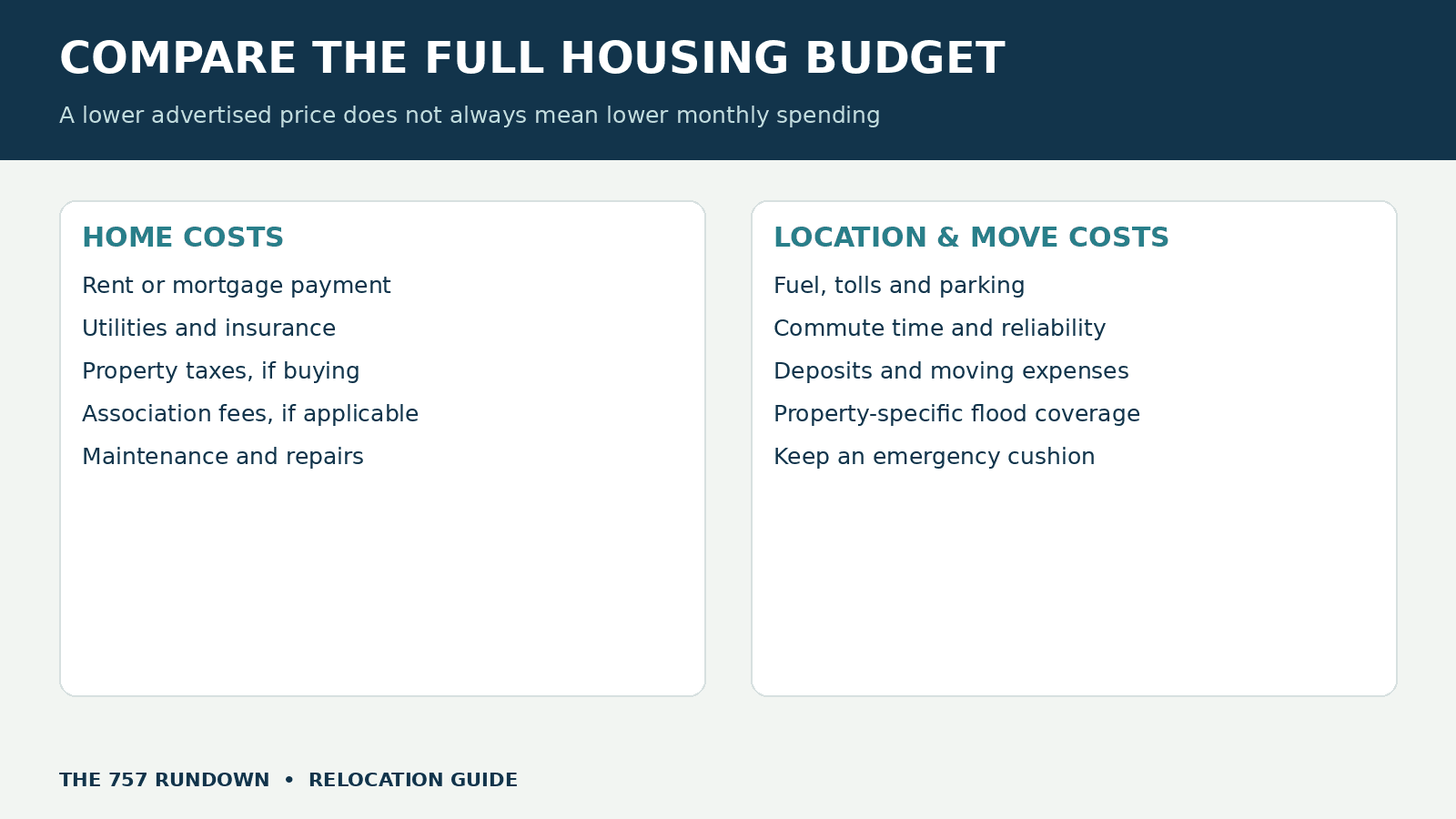
Before relocating, compare the full monthly cost of each option rather than choosing the lowest advertised rent or purchase price.
For the broader picture of cities, commutes, and local life, see our guide to moving to Hampton Roads.
Start With Housing, Then Add the Rest
Housing is often the largest expense to compare, but a regional median is not a quote for the home you want.
In August 2026, the median sales price of homes sold through the regional MLS was $388,950.
That describes completed sales in that dataset and month; it is not a city-by-city price ranking, a typical rental rate, or a prediction of your purchase budget.
Compare homes with similar size, condition, and features.
A waterfront location, newer construction, or desirable amenities can change the price substantially.
An older home may have a lower purchase price but require repairs that belong in your budget.
What Renters Should Compare
Ask each property manager for the complete monthly cost, including any mandatory fees.
Confirm which utilities are included, how parking works, and whether pet charges or amenity fees apply.
Check the lease length, renewal terms, and upfront deposits before comparing properties.
Request current availability and written pricing for the unit you would actually rent.
An advertised starting rate may describe a different floor plan or lease term.
Keep moving costs and deposits separate from your ongoing monthly expenses.
What Buyers Should Compare
A mortgage payment alone does not capture the full cost of owning a home.
Include property taxes, insurance, association dues where applicable, and maintenance.
Get property-specific estimates rather than assuming every home in the same city has identical carrying costs.
Ask about the condition of the roof, heating and cooling equipment, drainage, and major systems.
A comfortable monthly payment leaves room for upkeep and unexpected expenses.
Review flood exposure and discuss appropriate coverage with an insurance professional before committing.
Transportation Can Change the Housing Math
Hampton Roads geography makes transportation part of the housing decision.
A cheaper home on the opposite side of the harbor from your workplace may require more driving and less reliable travel times.
Compare the actual route during your usual work hours.
The Downtown and Midtown tunnels between Norfolk and Portsmouth have tolls that vary with travel time and payment method.
Those costs can accumulate if the crossing is part of your daily routine.
Check current rates for your vehicle and payment method rather than relying on a remembered price.
Include fuel, parking, vehicle maintenance, and any transit fares you expect to pay.
Time matters, too: a location that makes work, childcare, and errands easier may offer value beyond its advertised housing cost.
Utilities, Groceries, and Everyday Spending
Request information about typical utility use when available, while remembering that your household's usage may differ.
Home size, insulation, equipment, and summer cooling needs can affect bills.
Compare internet options and recurring service charges at the exact address.
Build a grocery budget around what you normally buy and where you expect to shop.
Include dining out, household supplies, phone service, and subscriptions.
People with children should obtain current childcare quotes and confirm availability rather than relying on a regional estimate.
A Hypothetical Example: Compare Two Rentals
Suppose Rental A costs $1,700 a month and Rental B costs $1,850.
If Rental A adds $200 in monthly transportation costs while Rental B adds $50, both total $1,900 before other expenses.
These figures are hypothetical examples, not Hampton Roads market averages.
The next comparison is what the totals leave out.
Are utilities included?
Is parking extra?
Does one option save substantial commute time?
Comparing a complete budget helps you spot trade-offs that the rent alone cannot show.
How to Compare Hampton Roads Communities
Include multiple neighborhoods in your search rather than assuming one city is always affordable and another is always expensive.
Hampton, Newport News, Norfolk, Virginia Beach, Chesapeake, Portsmouth, and Suffolk all contain varied properties and locations.
First identify the places you need to reach most often.
Then compare suitable homes using current quotes, realistic transportation costs, and property-specific considerations.
The best-value option is the one that supports your routine without stretching your household budget.
Your Monthly Budget Checklist
Write down housing, utilities, insurance, transportation, groceries, healthcare, childcare where relevant, and other recurring commitments.
For a purchase, include taxes, association fees, and maintenance.
Avoid counting an expense twice if it is already included in another payment.
Keep a separate allowance for deposits, moving services, initial setup costs, and an emergency cushion.
Update the comparison when quotes change.
A budget based on real properties and your own needs is more useful than a single regional cost-of-living label.
Plan Your Move With the Bigger Picture
Costs are only one part of choosing where to live.
Our guide to moving to Hampton Roads also covers the Peninsula versus the Southside, employment, military life, weather, and everyday amenities.
Subscribe to The 757 Rundown for local news, restaurants, events, real estate, jobs, and the stories shaping the region.
Get to know the 757 before you arrive and stay connected as you settle in. |




0 Comments
Join the conversation
Be the first to comment
Share your thoughts above.